Why We Need (a) Fashion Revolution
By Megan Baguley
The fashion industry is an industry that has seen significant shifts over time. However, these shifts are only sometimes the most ethical. As a result, in recent years, individuals and organizations like Fashion Revolution have been working tirelessly to redefine the industry's values and practices to strive for a brighter, more sustainable future. Megan Baguley delves into the evolving narrative of fashion and uncovers some of its harsh truths as she speaks with one of Fashion Revolution South Africa's representatives, Safiyya Karim.
Fashion's story begins in the 1800s when Charles Frederick Worth enters the scene and is accredited as the world's first fashion designer. Back then, fashion and style were characterized by simplicity and elegance. Women exclusively wore dresses with low-cut necklines manufactured from silk and enriched with embroidery. Meanwhile, men were the epitome of formality, often seen in tailored suits accompanied by waistcoats. As we move into the early 1900s, we witness fashion's first transformation. Here, women embrace newfound freedom, departing from dresses into shirts and blouses, textiles evolve from silk to nylon, and men bid farewell to their waistcoats, opting for a more casual style. Yet, the start of the 20th century kickstarts fashion's uprising. With the emergence of media, from TV shows and movies to music videos and fashion magazines, media had the absolute power to influence fashion trends around the globe. From then on, fashion became a topic that resonated with nearly everyone, whether through celebrity influence, to express individuality, uphold tradition, or even just for practicality.
We have now arrived at the 21st century, where the fashion industry is one of the largest industries in the world, with a labour force of over 3 million and a value equivalent to roughly 3 trillion US dollars. According to statistics published by Fashion United, if the global fashion industry were measured like a country's GDP, it would make up the world's seventh-largest economy.
But apart from its industry growth, it also expands its definitions and popularity. Today, streets worldwide are like runways, where personal style is spotlighted, and every passerby is a model of individuality. But fashion has also found a new canvas within the virtual world. Social media platforms and online spaces have become digital galleries, showcasing trends and sparking public interest. With a click and a swipe, the fashion world is at our fingertips, transforming our living rooms into fitting rooms. Yet, behind the scenes of our aesthetic feeds and walk-in wardrobes lies a dark narrative.
A pivotal chapter in this unfolding narrative unfolds on April 23, 2013. On this day, the Rana Plaza, a building that houses the operations of major global fast fashion brands, is reported to have large structural cracks. In response to the severe and seemingly dangerous damages, authorities alert businesses and factories within the building to close immediately. Many of them do, except for the garment factories, as their owners ignore this warning and tell their workers to clock in as usual the following day. Then, on April 24, 2013, a massive tragedy occurred. The eight-story building located in Bangladesh comes crashing to the ground, tragically claiming 1,134 lives and leaving more than 2,500 garment workers injured. But that's not where the story ends.
The collapse of the Rana Plaza is just one incident that exposes the fast fashion industry as one of the most significant human rights violators. Recent statistics revealed by the Human Rights Pulse indicate that 97% of fast fashion brands manufacture garments in developing nations. In these countries, workers are not only forced to work laborious hours in unsafe conditions, but an alarmingly significant portion of this labour force comprises of children and forced citizens. And here's another eye-opener: the fashion industry is also responsible for contributing to global warming. This is because we now live in a time where wearing a garment once has become the norm, leading to roughly 85% of textiles being dumped in landfills each year. Presented with these figures, we face a harsh reality: if this fast fashion and "throwaway" culture we have created persists, one-quarter of the total impact of the climate change crisis will be because of clothing consumption in the next three decades.
But amidst all of this tragedy, there is hope. This is where Fashion Revolution comes in. The product of Carry Somers and Orsola de Castro is born from the ashes of this tragedy and a shared belief that the fashion industry desperately needs a makeover. The result? Since Fashion Revolution was launched in the United Kingdom, it has transformed into a worldwide movement, touching down in over 90 countries, including South Africa, in 2014. Luckily enough, I get to speak to one of their South African representatives to dive deeper into Fashion Revolution's mission to mend the seams of an industry torn apart by its excesses.
Meet Safiyya Karim, Fashion Revolution SA's co-country coordinator. She sits down to tell us more about Fashion Revolution's aims and why we need a fashion revolution. As mentioned by Karim, "The organization aims to create a global fashion industry that conserves and restores the environment and values people over growth and profit." To bring these goals to life, Fashion Revolution works to forge a brighter future for the fashion world across three dimensions: cultural, policy, and industry change.
Cultural change involves Fashion Revolution educating individuals about the global fashion industry's inherent difficulties. This is done by developing engaging materials, helpful manuals, and creative events to inspire people to rethink how we purchase, wear, and dispose of clothing. Through this knowledge, an inclusive movement is established, unifying individuals from all over the globe and equipping them with the knowledge and skills they need to take action on fashion's impact.
Then comes policy change, where Fashion Revolution pressures governments to play a more active role in better enforcing laws and regulating the industry that will hold the fashion sector responsible. One way the organization has achieved this is by campaigning for a renewed International Accord on health and safety, which has successfully pressured companies to ensure the safety of their textile workers in Bangladesh and worldwide.
And finally, is that of industry change. Here, Fashion Revolution shines a light and advocates for a complete transformation in how the industry operates by demanding transparency and holding all players in the fashion game accountable. Through the Fashion Transparency Index, the largest and most influential fashion brands and retailers in the world are encouraged to be more transparent, which Fashion Revolution believes is essential to creating a more effective fashion industry.
Yet, as Karim points out, achieving these goals has its share of challenges. Fashion Revolution cannot do all the work alone; they need your help. But you may still be confused or think the fashion industry cannot be that bad. This is where Safiyya helps shed some light by telling us why we need a fashion revolution, as well as some hidden truths that the average consumer may not know and what we can do to help.
Karim is passionate about what she does. "We need a fashion revolution because no one should die for fashion," she says. She believes we need organizations such as Fashion Revolution and individuals pushing for change. Without them, the current human and environmental exploitation system will unlikely stop chasing profit. Brands are particularly guilty as they are driven by sales and profit. Take Zara, for example. Zara stands at the forefront of the global fast fashion industry, reaching a remarkable record of selling over 2.9 billion units in 2019 and earning a 56% profit every single second, according to Fashion United. To accomplish such drastic statics shows how fast fashion brands tend to set unrealistic timelines and pressure all the supply chains. Because of this, they also don't disclose these chains, which keeps us consumers ignorant of the human and environmental exploitation they cause. Then come the suppliers and manufacturers, who try to meet the unrealistic demands of brands by putting much strain on their workers to meet these deadlines, which in turn sets an unsustainable precedent as in this tight spot, they cut corners, often at the expense of their workers. Then, farmers, who are frequently overlooked yet essential. They contribute to ongoing issues in the fashion industry, including employing child labour, using harmful pesticides and water wastage through their crucial role in harvesting natural fibres such as cotton and hemp. Moving onto governments, who play another vital but rather troubling role. Chasing economic activity comes at a cost to the people who work in these industries and the environment. They also need to establish stronger labour laws and reduce fashion marketing greenwashing – like in South Africa, where high fabric tariffs hurt local designers against cheap fast fashion. Finally, fashion designers. Given their training within the current system, they often mimic what they have observed and been taught.
As you can see, we're lightyears away from giving the fashion industry a complete makeover. Somewhere along the line in our rapidly expanding world, fashion and clothing have lost their charm, and we no longer love and cherish them like we once did. Although it's not entirely our fault as consumers, it doesn't mean we can't help change the game. We, as consumers, have an upper hand as we hold the power to demand change. So, why not help Fashion Revolution and use it?
Are you prepared to join the revolution? Here are six things Karim says that you can do as consumers to kickstart change:
-
Start by signing Fashion Revolution's manifesto; it's a call to action for change.
-
To stay updated locally and globally, follow them on social media at @fash_rev_southafrica and @fash_rev.
-
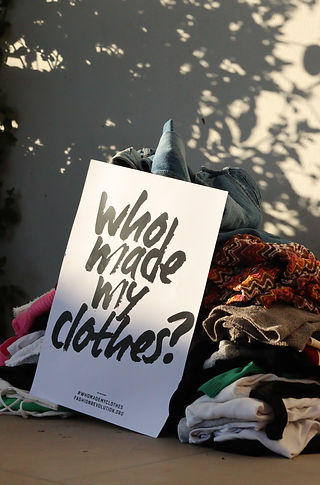
Don't just observe, participate. To increase awareness, ask questions like "Who made my clothes?" and "What's in my clothes?"
-
When shopping, make conscientious decisions. Consider buying used items, supporting local businesses, giving your old garments a second chance by fixing and restoring them, and trading your clothes with friends or at events.
-
Hold companies accountable for their sustainability commitments.
-
Remember that the most sustainable garment is already in your wardrobe.