
Crossing currents and conquering waste: A hero’s quest across the Volta River
By Saarah Hendricks
Imagine stepping outside of your home, only to be greeted by a pile of textile waste towering over 5 feet. Imagine you want to enjoy the beach but there are thousands of discarded items embedded in the sand, extending hundreds of kilometres across the coastline. This is the reality for many people living on the coast of Ghana. But what is the source of this unrelenting waste?

The Kantamanto Market in Accra, Ghana – home to the largest second-hand market in the world – imports a staggering 15 million items of clothing bales every week from the Global North and pays an average of $325 USD annually. Despite the efforts of 30,000 people, working six days a week to clean, repair, reuse and upcycle this clothing, 40% of each clothing bale ends up in landfill sites. This influx of clothing from the Global North ends up dominating the land and polluting water bodies. Called waste colonialism, the issue transcends mere textile waste, threatening the livelihoods of people in the Global South.
On 17 August 2023, TWYG hosted their annual Africa Textile Talks Event at V&A Waterfront, Workshop 17. The event was a full-day programme of connecting and learning about slow fashion and textiles. Speaking alongside various individuals, organisations and companies from across the African continent, the Or Foundation shared their research on the global trade of second-hand clothing in Ghana and its impact on broader society. The Or Foundation’s missionary approach is to create a more justice-led and circular textile system. Yvette Tetteh, a creative, entrepreneur, an athlete and a devoted member of the Or Foundation shared her story of swimming 450km across the Volta River to combat waste colonialism in Ghana. But what does a swim have to do with textile waste and the future the Or Foundation is working to create?
The Volta River sustains millions of lives, flowing from the northern regions of the Bobo-Dioulasso highlands of Burkina Faso and into the southern region of Ghana. Building upon the OR Foundation’s existing research, The Agbetsi Living Water Expedition is an environmental campaign that looks at textile waste and its effect on the quality of water bodies. The expedition forms part of the OR Foundation’s broader #stopwastecolonialsm campaign and in support of the Or’s push for Extended Producer Responsibility (EPR) policies across the world.
“It’s very affecting to see images of these piles of t-shirts or to hear from people, so over the course of 40 days, my team and I journeyed down the Volta collecting water and air samples and really just talking to people we encountered along the way,” said Tetteh.
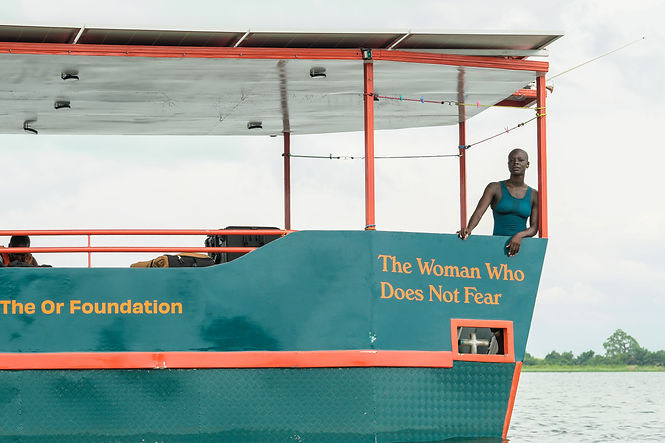
The first solar-powered research vessel in Ghana – called the Woman Who Does Not Fear –was custom-built for the expedition. Tetteh said that the goal of collecting samples was to check for the presence of microfibres that are polluting the Volta River and to build a rigorous scientific data plot on the problem. The water sample is pushed through a microfibre and micro-glass filter and examined under a microscope using different lights – blue lights, UV lights and bright lights. Each microfibre is then counted individually with the naked eye.
.jpg)
Tetteh shared, “What we're actually hoping to do is to put out the research as a paper and hopefully documentary in March 2024, the anniversary of the swim.”
While the results can take several moments to process, Tetteh and the team hypothesise:
“Someplace like Accra, there's a lot of human development and a lot of human interaction with the environment and there's a lot of consumption and use of clothing. So what we were expecting to see and hoping to see is that in places that are less developed, we're going to see a much less presence of microfibers.”
The expedition’s vision extended beyond mere scientific research. To provide a more “comprehensive picture” of the expedition’s goal, Tetteh noted that a group of 12 writers, artists and creatives were commissioned to share their unique perspectives and experiences along the Volta River. It was an opportunity for the team to interact with people along the Volta River, voicing their concerns.
“Unsurprisingly, second-hand clothing from the Global North wasn’t at the top of their list of concerns,” said Tetteh. They're thinking about climate change; they're thinking about receding water levels; they're thinking about the change in the fish harvest.”
The ultimate goal of their project was to drive policy change. To do so, the OR believes that we must first collect real data to understand the real problem. Second, we must catalyze cultural change by raising awareness and inspiring people to take part. Tetteh noted that although the second-hand trade in Kantamanto is such as massive industry, it is somehow invisible or “invisiblised”.
“What we wanted to do with this whole expedition was to make something that seems invisible visible to those who are not directly involved,” Tetteh explained, “and to keep understanding all the different facets of our lived reality.
“It's not just about the swim, it's about the research,” said Tetteh. “Journeying down the Volta River, we got a ton of photos, a ton of video footage and it was so encouraging and inspiring because it really helped us feel that there was still an opportunity for us to enact change.”
In the closing lines of her presentation at the TWYG event, Tetteh highlighted the importance of teamwork and the power of breaking down monumental challenges into manageable steps.
“If we're working together as a team, if we're breaking things down into scale, then it suddenly becomes actually realistic to be able to swim 450 kilometres or to swim four hours in a row, or to build a fully solar-powered research vessel.”
Tetteh also reflected upon her journey and left the audience with an unwavering message. She anticipated that the last day of swimming would be the easiest, but nature had other plans. The powerful current and relentless wind conspired to pull her back, yet her resilience and strength held steadfast.
“It was a really long way, it was extremely difficult. I trained for about seven months to be able to do it. On the last day, I actually ended up swimming four hours without stopping or getting out of the water. I was thinking to myself, I actually really wanted to cry because I was really tired.”
Tetteh said that there were moments when the journey seemed impossible, but she acknowledged that it was part of a cause much larger than herself. She reminded us that fear and powerlessness are merely perceptions and feelings we hold within us.
“I think it's also important for us to think about this idea of impossible being just a feeling, because when we are thinking about, the immense global second-hand clothing trade, or the problem of trying to make fashion sustainable or, climate change, it's so easy to feel overwhelmed and disempowered by how huge it is. But the point is that sometimes impossible is just a feeling, and we need to move through that and work together to find solutions that are actually possible for us to do each day.”
Lastly, she reminded the audience that waste colonialism remains a serious issue in Ghana, but the OR Foundation is working to conquer it. In support of the #stopwastecolonialism campaign, the Foundation urges everyone to take action by signing the petition on their website: https://community.theor.org/petition?source=widget
.jpg)